
AI blog writing got much better in less than one year. I know because less than a year ago I was trying to use AI to speed up blog production for a company. It produced words quickly, but the articles were generic, poorly structured, and missing the knowledge that made the company different.
Today, the experience is almost unrecognizable. Stronger AI models are part of the reason, but the bigger change is that I can now give an AI agent local context, a reusable Skill, current research, and my answers before it writes a complete draft.
For me, that has reduced the distance between having useful experience and publishing it. I can develop an article through short conversations between other tasks, even though English is not my first language. I still own the judgment, corrections, and final approval.
A fast draft was not the same as a useful article
Around a year ago, I was working for a company and wanted to see whether AI could help us create blog articles faster. The opportunity seemed obvious because starting with a draft should have been easier than starting with a blank page.
The speed was real. The usefulness was not.
The drafts repeated information that was already available online. Their structure was often weak, and important company-specific information was missing. They could sound confident while saying very little about the company itself.
That was not a small editing problem. If the article contained no company knowledge, experience, or point of view, I could not see a good reason to publish it.
Even so, I did not stop experimenting because I expected the technology to improve and wanted to understand its limitations early. Getting hands-on experience felt more useful than waiting until someone declared the tools ready.
That decision gave me a clear comparison. I remember what the process could not do then, which makes the change today much easier to see.
Many of the articles I wanted to write stayed in my head
Beyond the company experiment, I had wanted for years to document my own experience.
Writing gives me a public record of what I know and how I think. My problem was not a lack of ideas, but the time between having an idea and turning it into a complete article.
A useful article can easily reach around 1,500 words. I can write in English, but because it is not my first language, developing the argument, finding the right structure, checking the language, and polishing the complete article could take me too long.
So many ideas remained exactly where they started: in my head.
Early AI tools shortened the route to a first draft, but they did not close the gap. A generic draft was faster, but it still did not sound personal enough to publish. What I needed was a way to help an AI agent understand the experience behind the article.
What changed was the system around the AI model
AI models improved, but that improvement alone does not explain the difference.
I now use Codex inside the ChatGPT desktop app. OpenAI’s documentation for the ChatGPT desktop app explains that it can use the files and context in a folder I open. My local project can contain the content strategy, topic bank, existing articles, voice rules, SEO decisions, research notes, and publishing requirements.
Alongside that local context, I can use Skills, which OpenAI’s Skills documentation describes as reusable workflows that package instructions, references, and optional scripts. For me, a Skill is the process I want the AI agent to follow each time I create an article.
The AI agent no longer receives one isolated prompt and then guesses the rest. It can review the relevant context, research the reader’s question, interview me one question at a time, and follow the same review process for every article.
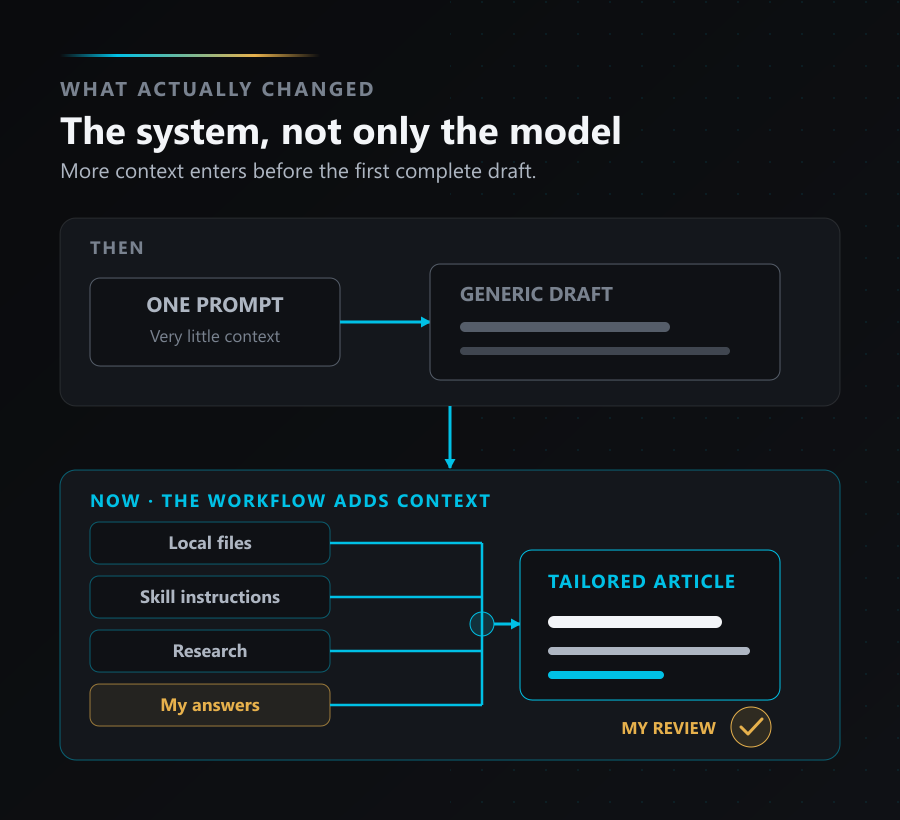
AI did not replace my experience. It gave me a much better way to turn that experience into an article.
This article exposed the next part of the workflow
This article started as a rough comparison between my experience a year ago and the way I work now. The AI agent checked the topic bank and content map, researched the questions people ask, proposed several directions, and interviewed me.
I explained why I started testing AI writing, what disappointed me, why I kept experimenting, what changed, and why writing in English created extra friction for me. Together, those answers contained enough information for the article.
The first draft captured those facts accurately, but it organized much of them as explanation. The workflow and SEO sections became more prominent than the decision story behind them.
That showed me that a good interview is not enough on its own. Before drafting, the AI agent also needs to reconstruct the story: the problem, the tradeoff, the decision, the outcome, and the lesson for the reader. Otherwise, useful personal material can still become polished but impersonal prose.
Rather than repeat the interview for this version, we returned to the original conversation, confirmed that the context was already there, and used it to rebuild the article around the operating decision.
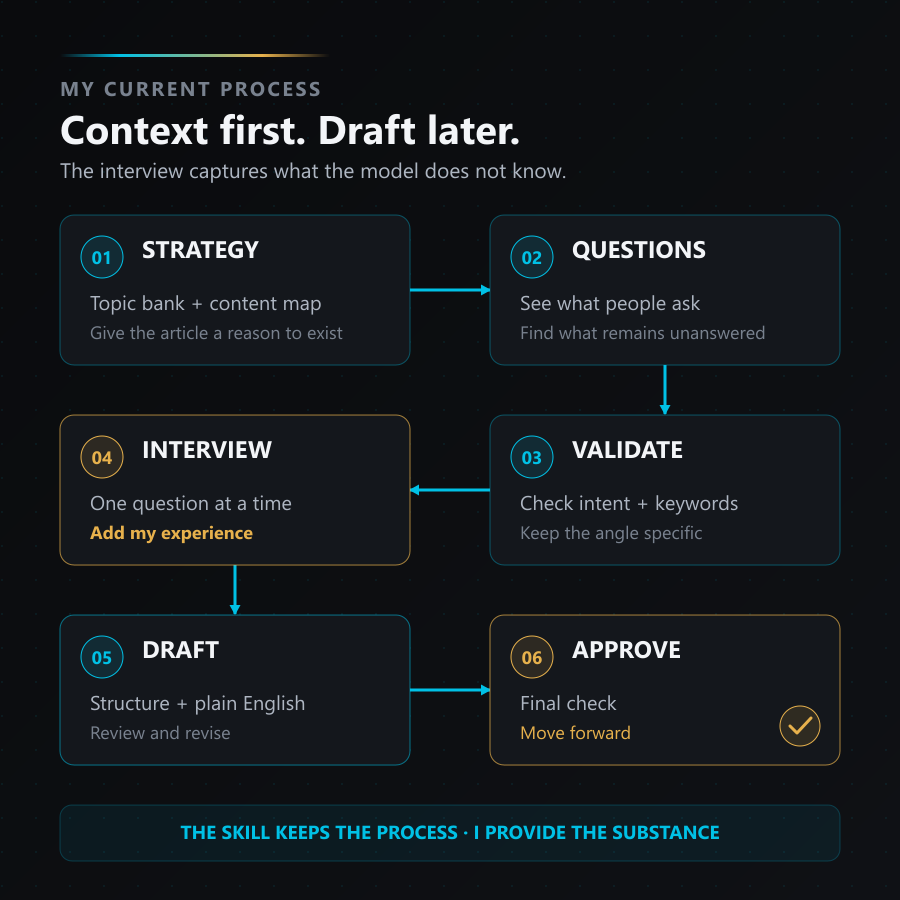
This is also how I want the workflow to improve. When a draft reveals a repeatable problem, I correct the article and update the Skill responsible for that part of the process.
A better workflow does not make my review optional
I still review every article, checking the facts, sources, examples, structure, and tone. I change sentences that are accurate but do not sound like me, narrow claims that are too broad, and clarify the context when the AI agent misunderstands a quick answer.
This matters because my interview answers are source material, not finished prose. I often answer quickly to save time, and English is not my first language. The AI agent should preserve my meaning, judgment, and genuine expressions without treating rushed wording or imperfect grammar as my final writing style.
The final article should sound like me explaining the issue to another person. It should not sound like a transcript, and it should not sound like generic corporate thought leadership either.
The AI agent can recommend corrections, but I decide whether those corrections improve the article. Faster production is useful, but giving up that responsibility would defeat the point.
SEO makes first-hand context more valuable
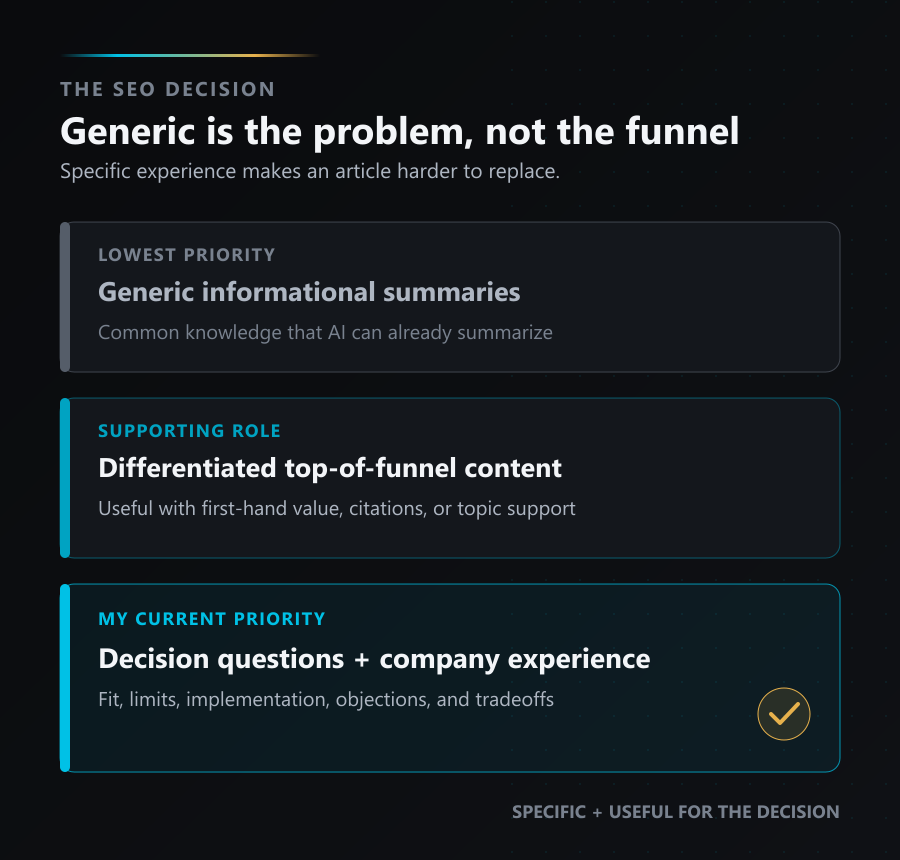
Search has changed during the same period. Broad informational articles once attracted large amounts of top-of-funnel traffic, but AI tools and search summaries can now answer many common questions without requiring another generic article.
Google’s generative AI content guidance does not say that AI-assisted content is automatically bad. It warns that generating many pages without adding value can violate its scaled-content policy. Google’s AI search guidance recommends first-hand, non-commodity content that provides more than common knowledge.
Ahrefs’ AI Overview research found that AI Overviews appear especially often for question-based and informational searches. One B2B SEO specialist, in an analysis published by Search Engine Land, describes putting more effort into mid- and bottom-of-funnel content while retaining differentiated top-of-funnel articles as supporting structure.
I would not say top-of-funnel SEO is dead, but generic information is a weaker investment. I would prioritize specific questions connected to a real decision, then answer them with company knowledge, direct experience, honest tradeoffs, and evidence.
Bottom-of-funnel content is not automatically protected either. Semrush’s commercial-intent AI Overview study found that AI Overviews on commercial-intent searches grew during the research period. Choosing a commercial keyword does not make an article useful on its own. The article still has to add something beyond what an AI model can produce by summarizing the same public pages.
Start with the context you want the article to preserve
If you have useful experience but struggle to turn it into complete articles, I would not begin with a blank prompt asking an AI agent to write 1,500 words.
Start with the context another person would need to understand your decision. What problem were you facing? What options did you consider? What did you decide? What happened? What would you recommend to someone facing the same situation?
Then give the AI agent a repeatable process for research, interviewing, drafting, and review. I have written separately about why Codex Skills save me repetition but not review. The Skill should carry the process. Your answers should carry the substance.
Less than a year ago, AI blog writing was not good enough for what I wanted to publish. Today, it is useful enough to help me publish what I already know, provided I give it the right context and review the result myself.
That is the change I care about. It is not more content for the sake of producing content, but a more practical way to turn experience into something another person can use.